Abstract
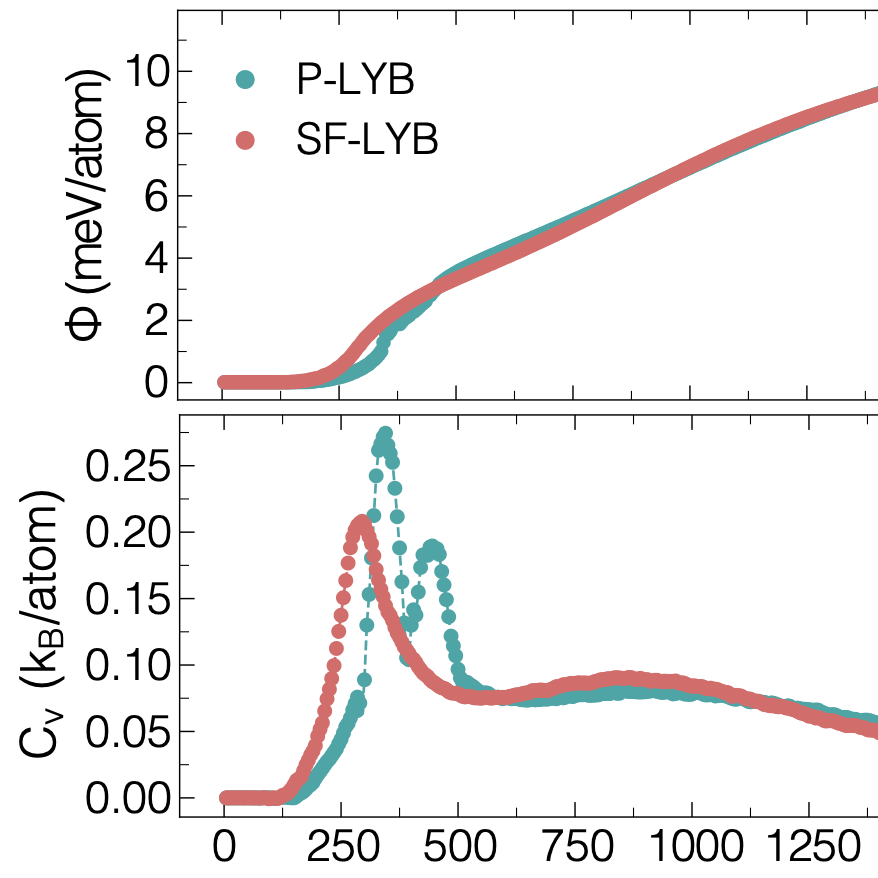
Despite the prevalence of stacking faults (SFs) as planar defects in crystalline materials used for energy applications, their thermodynamic stability and influence on Li-ion transport in ternary halide solid electrolytes (SEs) for all-solid-state batteries (ASSBs) remain poorly understood. Here, we combine firstprinciples-trained cluster-expansion Hamiltonians and Monte Carlo simulations with machinelearned interatomic potentials to investigate SFs in trigonal Li3YCl6 (LYC) and monoclinic Li3YBr6 (LYB), two promising SEs compatible with high-voltage positive-electrode materials. SFs in LYC are metastable. In LYB, SFs are nearly energetically degenerate with the pristine phase. Nanosecond-scale molecular dynamics simulations of thermodynamically accessible faulted structures show that SFs increase Li-ion conductivity in LYC by an order of magnitude while lowering the Li-ion migration activation energy from 0.33 (in the bulk) to 0.21 eV. The analysis suggests that this enhancement arises from the disruption of the rigid Li sublattice ordering and the activation of threedimensional diffusion pathways by SFs at low temperatures. Our approach provides a general protocol for screening SFs in layered materials, including ion conductors. We show that defecttransport coupling is strongly framework dependent, highlighting synthesis-controlled defect engineering as a route to tune ionic conductivity in halide SEs and potentially other ion conductors.