Abstract
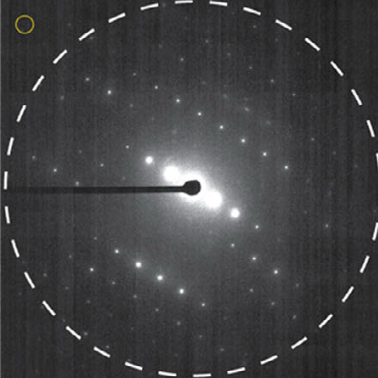
Organic electrode materials (OEMs) offer a sustainable alternative to inorganic cathodes but typically suffer from low intrinsic electronic conductivity. The material historically reported as bis-tetraaminobenzoquinone (TAQ) exhibits bulk conductivity two orders of magnitude higher than its close analogue, tetraaminophenazine-tetraone (TAPT), despite their common precursor and nearly identical short-range structure. This disparity has previously been attributed to distinct molecular skeletons, with TAQ proposed to adopt a piperazine-type linkage and TAPT a pyrazine ring. Here, combining synchrotron X-ray scattering, solid-state 15N and 13C nuclear magnetic resonance (NMR), microcrystal electron diffraction (MicroED), and continuous-wave and pulsed electron paramagnetic resonance (EPR) spectroscopy, we show that “TAQ” has the same pyrazine-based molecular structure as TAPT, with no evidence for a piperazine core or keto–enol tautomerization. Their key difference lies in the synthesis-dependent degree of crystallinity: “TAQ” exhibits greater long-range structural coherence and a crystallographically resolved intermolecular hydrogen-bonding network, whereas TAPT is more disordered. EPR further shows that the higher structural order in “TAQ” is associated with a strongly delocalized π-spin manifold, while TAPT favors localized or weakly delocalized radicals and stronger local spin coupling. These findings identify the degree of crystallinity and hydrogen-bonding order as key structural features associated with radical delocalization and enhanced conductivity in organic electrodes.