Abstract
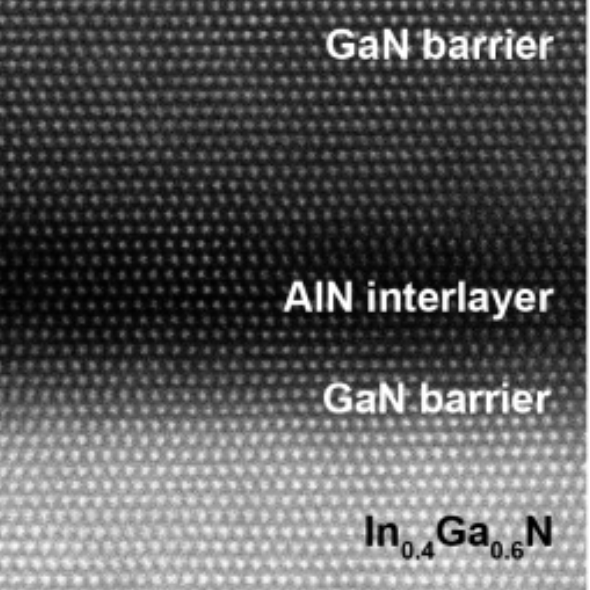
Modern high-electron-mobility transistors (HEMTs) and light-emitting diodes (LEDs) are engineered around epitaxial indium gallium nitride (InxGa1−xN) heterostructures. We apply the highest-resolution structural, elemental, and optical characterization to a series of systematically-fabricated GaN-on-silicon (Si) epitaxial heterostructures and demonstrate hitherto unresolved nanoscale optical inhomogeneities in individual InxGa1−xN quantum wells. Direct correlation of atom probe tomography and scanning transmission electron microscopy with cathodoluminescence collectively confirm that these optical inhomogeneities result from compositional segregation that only appears in high indium-content InxGa1−xN specimens, but not in low indium-content quantum wells, thereby elucidating the origin of injection-current-induced blueshifts in long wavelength LEDs. Density functional theory (DFT) calculations of the various alloy mixing energies indicate that the relaxation of the epitaxial in-plane strain stabilizes specific InxGa1−xN compositions. Our findings suggest both the proper use of strain management, and the careful selection of alloy composition, are necessary to control local phase separation. This work presents a path to high-mobility strain engineering in HEMTs and homogeneous, long-wavelength light emission in LEDs.